Stronger by Spring
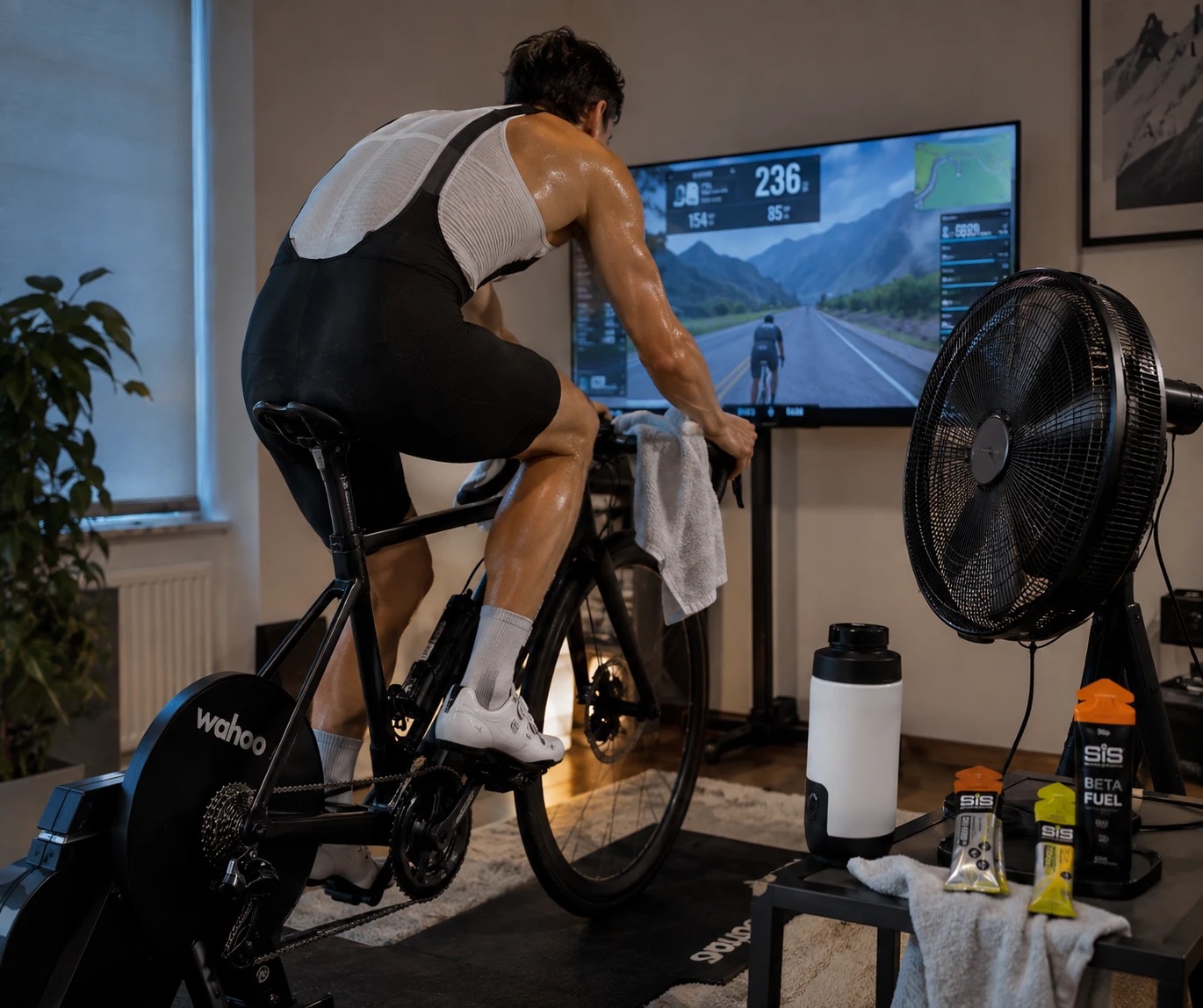
For the rider who will spend the winter on a smart trainer and wants to come out of it with more engine for the first group ride of spring — on four to six hours a week. Indoors the hours are short and the temptation is to make every one of them hard. The research says otherwise, and it is unusually clear about what to do instead: in a randomised trial of recreational cyclists, 4×8 minutes twice a week beat shorter intervals, longer intervals and easy-only riding by roughly double over seven weeks. This plan is built around that dose, rotated with 30/15 short-short intervals, filled out with easy rides of 60 to 90 minutes, and bracketed by the same indoor FTP test at the start and the end. Nothing is longer than ninety minutes. Every session says which trainer mode to use and what evidence stands behind it — and where the evidence runs out, it says that too.
The assistant adapts these sessions to your event date, days and fitness — then drops the whole block on your calendar. One conversation, no blank calendar.
Count sessions, not zones
At four to six hours a week, '80/20' is a rounding error you cannot act on. What you can act on: two quality sessions and easy riding around them. A fifth and sixth hour go into more easy riding — never into a third hard day. Recovery, not ambition, is the limit.
Per hour, intensity pays
A 2025 meta-regression of 353 studies found endurance, interval and sprint training raise mitochondrial content by about the same amount — but per hour spent, interval training was about 1.7× and sprint training about 3.9× as efficient. When time is the constraint, the hard minutes are where the return is.
The tested dose: 4×8, twice a week
In trained recreational cyclists: +11.4% combined in VO2peak, power at VO2peak and threshold power after 7 weeks — against +5.5% for 4×4, +5.6% for 4×16 and +4.2% for easy riding only. Hardest you can hold evenly for all four, two minutes easy between.
Make the room work
A real fan in front of you: in a hot-room lab test, still air or a light breeze left body temperature and perceived effort higher than proper facing airflow. ERG for steady work, resistance mode for sprints, 30/15s and tests. And test indoors — train off the number you can produce where you train.
- —Which week is yours: 4 hours = two quality sessions + two Easy Hours. 5 hours = two quality sessions + Endurance 90 twice. 6 hours = that plus an Easy Hour on Wednesday. The hard part of the week is identical in all three — more time buys more easy riding, which is exactly what the evidence on low-volume training points to.
- —The 12 weeks: Week 0 — FTP Test, indoors. Weeks 1–2 — 30/15 Starter + Ten-Second Sprints, easy rides at the weekend. Weeks 3–8 — 4×8 twice a week (the tested dose; the trial ran seven weeks). Weeks 9–11 — rotate: 30/15 × 3 on Tuesday, 4×8 or Threshold 2×15 on Thursday. Week 12 — two easy days, then the FTP Test again.
- —Cooling is part of the session, not a comfort. Put a proper fan in front of you and switch it on before the warm-up ends: in a lab test in a hot room, still air or a light breeze left body temperature and perceived effort higher than real facing airflow — the same watts simply cost more. Under 60–90 minutes, drink to thirst; water is enough.
- —Trainer mode by session: ERG for Easy Hour, Endurance 90 and Threshold 2×15, and for 4×8 once you know your number — it is a compliance tool for steady work, not a better stimulus. Resistance or slope mode for Ten-Second Sprints, 30/15 and the FTP Test: anything maximal or changing every few seconds. That mapping is practice — no trial has shown either mode trains you better.
- —Keep at least one easy or rest day between the two quality sessions. Any two days work — Tuesday and Thursday are just the most common gap in a working week.
- —Progress the watts, not the count. 4×8: when all four reps were even and the last one felt controlled, add 2–3% next time. 30/15: add reps before adding a set. Sprints: add one every second session, up to six.
- —The week with no time: do Ten-Second Sprints (40 min) instead of the missed session. Do not squeeze both quality sessions into two consecutive days to catch up.
- —Take an easy week when the signals say so, not because it is week four: the same watts feeling harder, a session you could not finish two times in a row, sleep or mood sliding for several days. Easy week = keep one quality session, shorten the easy rides.
- —When spring comes: swap the weekend's indoor rides for the outdoor ones you were training for, and re-test outdoors before you trust the number there. Power outside varies about twice as much as on the trainer at the same average, and a fixed trainer loads the quads more than the road does — the first rides out will feel different, and that is normal.
- —Optional, if you have time beyond the riding hours: two short heavy strength sessions a week (3–4 lower-body lifts, 4–6 reps, stopped short of failure) buy efficiency and late-ride power — not a bigger engine. If it has to come out of the riding, skip it.
- —What the evidence covers and what it does not: 4×8, 30/15 and short sprints have training studies behind them (the first in recreational cyclists, the second in trained-to-elite riders, the third mostly in non-athletes). The easy rides and their length, the split of the fifth and sixth hour, threshold 2×15, the trainer-mode mapping, the 12-week order and the two-sessions cap are practice built on that evidence, not tested as a package. The %FTP numbers are starting points; the studies set intensity by effort and heart rate.
The sessions
Built from the Blocks knowledge base: Seiler et al. 2013 (4×8 vs 4×4 vs 4×16 vs easy, recreational cyclists, RCT); Rønnestad et al. 2020 (30/15 short intervals, elite cyclists); a 2024 randomised crossover on 30/15 in well-trained women and men; Gist et al. 2014 (sprint interval training meta-analysis, 16 RCTs); Hazell et al. 2010 (10-s vs 30-s sprints); Mølmen et al. 2025 (meta-regression of training type on mitochondria, 353 studies); a 2022 study of time to exhaustion at FTP20 across 87 cyclists; indoor-specific work on airflow and heat storage (2005), indoor versus outdoor power in professional (2022) and competitive (2019) cyclists, and muscle activity on a fixed trainer (2013); and the base's frameworks on intensity by weekly hours, ERG mode, threshold work, testing, drinking, deloads and individual response. A general plan, not a personalised prescription.