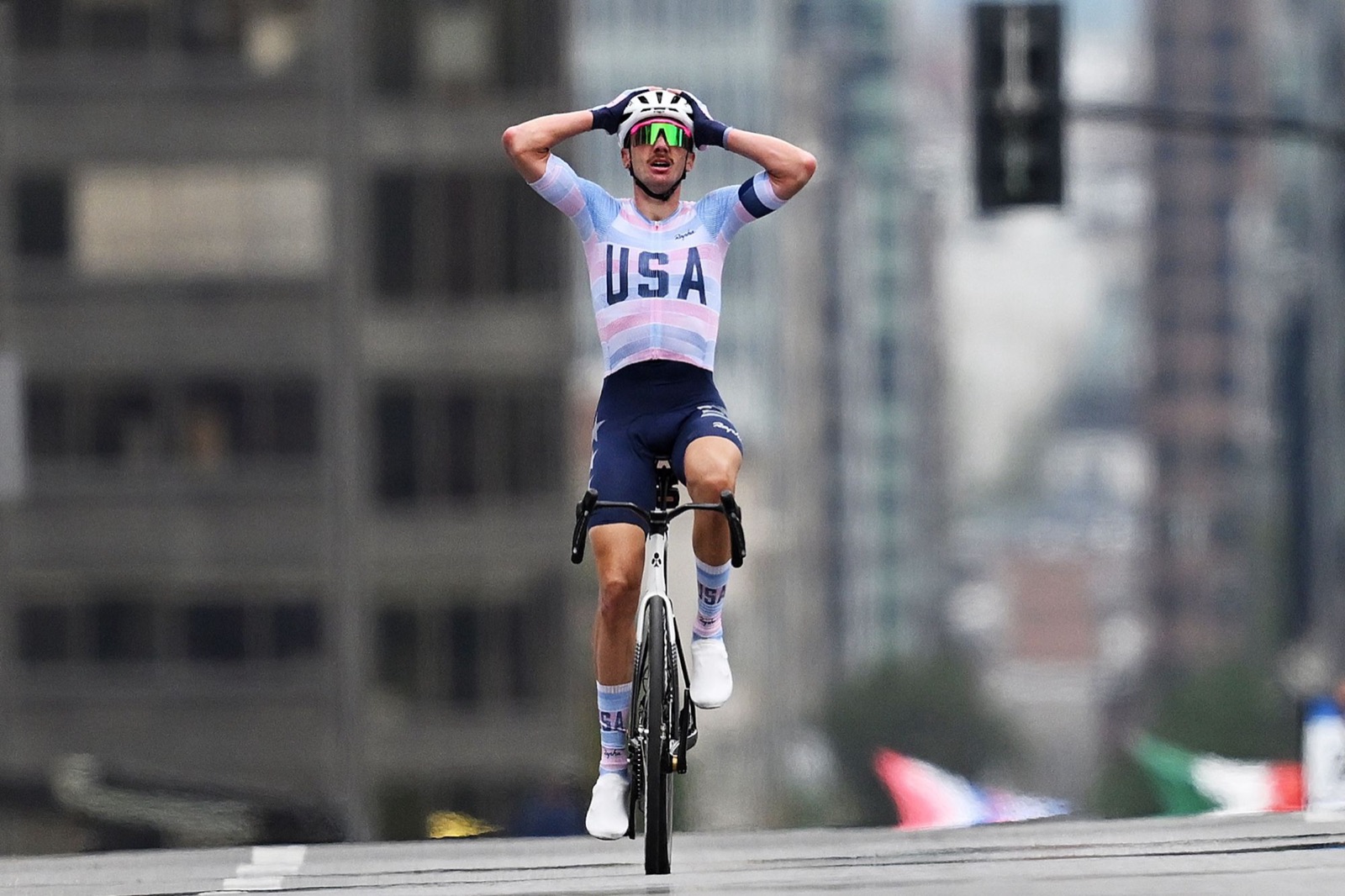
On 23 July 2026 Brandon McNulty (UAE Team Emirates XRG) abandoned the Tour de France ill, two days after a driver knocked him off his bike. He didn't ride for ten days. Then he went home to Arizona and trained for five weeks, building to 20–26 hours a week in desert heat, before flying to Canada: GP Québec, third at GP Montréal, fourth in the Worlds time trial — and on 27 September a solo attack 33 km out that made him the first American men's road world champion since 1993. These are the sessions from that block, read off his own Strava: lap by lap, with the terrain and his heart rate. His power is hidden, so the %FTP targets are our estimate from his heart rate; the structure is exactly what he rode.
The assistant adapts these sessions to your event date, days and fitness — then drops the whole block on your calendar. One conversation, no blank calendar.
Three blocks of 30–40 minutes at tempo, four times in 17 days — heart rate 144–155, far above his easy rides and below his threshold. It is the one session he repeats; everything else rotates.
Seven different interval sessions in four weeks: hill repeats, climbs plus a tempo hour, 30/30s, over-unders, six fours with sprints, sprint-and-hold, 40/20s behind a motorbike. Sprints turn up everywhere — climber or not.
Easy days at an average heart rate of 121–125. Not one full rest day in the four-week August block — the recovery is a short, genuinely easy ride. One long day a week, 4–5 hours, steady.
An hour on the trainer at about 140 W, a few hours after a desert morning ride — before the Tour and again before Worlds. And three weeks out, nearly three hours behind a motorbike at race speed.
- —If you train 8–10 hours: one Tempo 3×35 in its amateur version mid-week, one hard day from the rotation at the weekend, one long ride of 3–3.5 hours, and everything else short and truly easy. That is his structure at a third of the hours — which is the part worth copying.
- —The shape repeats; the hard sessions rotate. Two tempo days, two interval days, one long day, the rest short and genuinely easy — seven riding days a week, no full rest day inside the block.
- —He came back gently: after ten days off, the first week was four rides of 2–3 hours (~11 h). The full weeks that followed were 20.5, 26, 22 and 22 hours. Copy the ramp, not the ceiling.
- —Heat Hours go on easy days, a few hours after the morning ride — about one a week in the last three weeks before a hot or important race.
- —Three weeks out, back to back: Sprint & Hold, then motorpacing with 40/20s. Then the Canadian GPs as racing (11 and 13 Sep), a lighter week of ~13 h around the time trial — and, unusually, 4.5 h and 5 h rides five and four days before the road race, the Race-Week Sharpener three days out, two short spins, race.
- —Honesty note: lap times, reps, recoveries, terrain and heart rate come from his rides of 3 Aug – 24 Sep 2026 (plus the May–June heat sessions). His power is hidden on these files, so every %FTP here is an estimate from his heart-rate bands — easy 120–125, endurance 132–140, tempo 144–155, threshold climbs 154–163, VO2 efforts 160–171, max ~180 bpm. Set the targets from your own FTP, and treat the heart rates as his, not yours.
Read from Brandon McNulty's public Strava activities, May–September 2026 (lap tables, heart rate, terrain, segment efforts), with context from coach Jeroen Swart (Cycling Weekly, May 2026), UAE's performance staff (Beyond the Peloton, Dec 2025) and race reports of the 2026 World Championships. Power is hidden on his files; intensities are estimated. A reconstruction, not an official UAE Team Emirates plan.