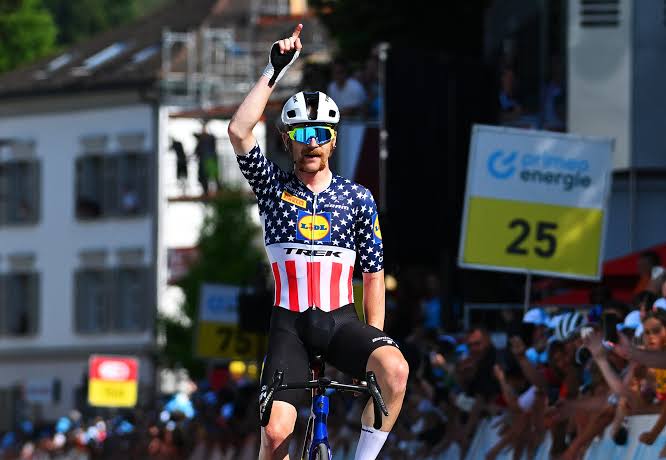
Quinn Simmons (Lidl-Trek, US road champion) says it plainly: he has no freak sprint, no freak hour-power, unremarkable w/kg — and he beats that with consistency and exceptional fatigue resistance. This is a reconstruction of his off-season under coach Steven de Jongh: 28–30 hours a week from November on, intervals that only ever come after hours of load, and a stubborn refusal of shortcuts — no gym maximal work, no ketones, no fasted rides. The engine is built by doing the work.
The assistant adapts these sessions to your event date, days and fitness — then drops the whole block on your calendar. One conversation, no blank calendar.
28–30 h/week starting in November. No 'build block before a goal race' — the block IS the whole winter, repeated week after week.
The signature weapon. Train tired on purpose: 6–7 h rides two days before races; intervals always AFTER hours of load, never fresh. If the efforts still fire after 5,000 kJ, he's race-ready.
Long rides at FatMax — 'hard but comfortable' pressure just under VT1 — plus low-cadence strength-endurance at the lactate-identified weakness zone.
No gym lifting — just 30–45 min of core for lower-back health. No fads. Trains solo and lives at altitude (Colorado, 2,100 m) instead of chasing camps.
- —Volume is the non-negotiable backbone — long rides almost every day; two hard key sessions per week, always built on top of accumulated fatigue.
- —Load before intensity, always: power is never tested early in a ride. The physiological target is durability — holding quality output after thousands of kJ, which predicts road racing far better than fresh 5-min power.
- —No taper between hard days mid-block. Recovery comes as a cluster: a planned overreach (e.g. three 6–7 h finisher rides), then four easy coffee-ride days.
- —No gym strength — low-cadence torque work on the bike plus 30–45 min core/stability for lower-back health.
- —Fueling is part of the training: 120+ g carbs/hour on long days, eating every 20 min; key intervals ridden fueled and caffeinated like race day.
- —Honesty note: session watt targets are published as raw power; the %FTP here divides them by an estimated FTP (~415–430 W from a 36-min @ 430 W race effort) — treat percentages as approximate and anchor to your own FTP.
- —Amateurs: do NOT copy 28–30 h. Take the structure — load-before-intensity, occasional deliberate training-tired, aggressive fueling — and scale the hours down hard (each session note carries its amateur version).
Compiled from Simmons' EVOQ.BIKE interview (Sept–Dec 2025) and cross-checked race power analyses (Domestique, Velo). A reconstruction, not an official Lidl-Trek plan.