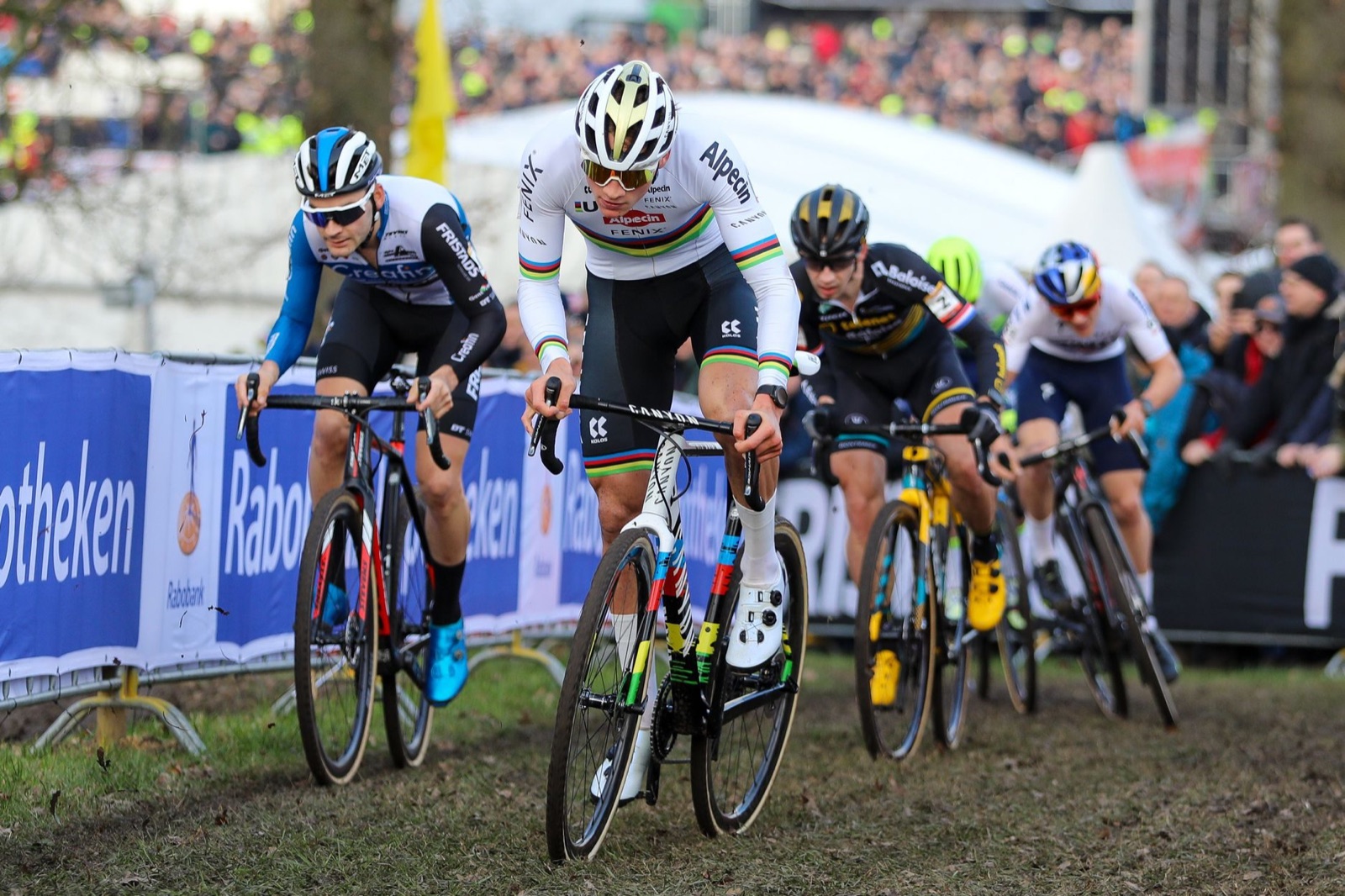
A cyclocross race is forty-five to sixty minutes almost entirely above threshold: heart rate sits within a few percent of maximum from the gun and stays there lap after lap, and the power file is a hundred-plus surges over FTP, five to thirty seconds each, separated by corners, run-ups and coasting. It is not one effort — it is a hundred, on a base. That base cannot be built in six weeks, which is why the road stars enter the season the way they do: van der Poel and van Aert arrive in December with months of road riding, touch the cross bike two weeks before their first race, and ride endurance on the road between crosses. This block copies the shape. Weeks 1–3 sharpen what six weeks can sharpen — the start, the repeatable surge, threshold with a burst every minute, and a rehearsed race day. Weeks 4–6 race: the weekends are the intensity, mid-week is one simulation and one engine ride, and everything else is recovery.
The assistant adapts these sessions to your event date, days and fitness — then drops the whole block on your calendar. One conversation, no blank calendar.
Race rank in cross tracks four-minute and twenty-minute power, not peak sprint. Those were built on the road this summer; six weeks can only add the specific edge and keep the base alive. Chasing fitness now leaves you tired in October.
Cross is threshold with a spike every fifteen seconds and a fifth of the race not pedalling. Train repeatability at 150–200% FTP on a threshold floor — 30/15s, bursts inside threshold, simulated laps — at the low, forceful cadence the mud demands.
Off-road, start position explains most of the finish, and a fast start is physiologically right: it kicks oxygen uptake into gear sooner. Rehearse the whole sequence — clip-in, all-out twenty seconds, two minutes above threshold to hold the wheel.
Two races a weekend already supply the intensity. Mid-week: one simulation, one road endurance ride, one short gym session every 7–10 days to keep the strength you built — and no third hard day. Between races the pros recover; the amateurs who fade by January trained through.
- —The six-week arc: weeks 1–3 sharpen with two cross-specific sessions a week (Starts, 30/15, Threshold + Bursts, Race Simulation in rotation), a skills day on the cross bike, one Road Engine ride and the gym. Weeks 4–6 race: the weekend is the intensity, mid-week is one simulation and one engine ride. Never more than three hard days a week, races included.
- —Skills day is on the cross bike and easy: dismount and remount at walking speed until it is automatic, then at speed; barriers; corners on grass and gravel; a lap at race pace only to learn where to brake and shift. Technique learned slow transfers; technique learned tired does not. If you enjoy running, ten to fifteen minutes of short hill sprints fit here — cross running is ten to twenty seconds at a time, never a jog.
- —Two races on a weekend: Wednesday becomes Road Engine and Thursday stays easy; the second race is the second hard session. One race: Sunday is the Road Engine ride. The engine ride is the one that keeps the base alive through a season of forty-five-minute efforts — the pros ride it even on race day.
- —Strength: keep one short heavy session every 7–10 days (the In-Season Maintenance 30' session from Gym for Cyclists), Monday or Thursday, never within 48 hours of a race. Dropping the gym for eight weeks measurably loses sprint and peak power mid-season.
- —Race day: warm up short and finish 10–15 minutes before the gun, keep the thighs actively warm on the grid (heated pads beat leg warmers), caffeine about an hour before at a modest dose. Eat the usual breakfast three hours out; nothing is needed during a race this short. Heart rate is useless for pacing in cross — it is near max from the first minute — ride by feel and by the wheel in front.
- —Pacing: the start is all-out for the first corner, then the race is won at threshold by whoever spends the fewest matches. Save the big surges for gaps that matter; a surge on every straight is how amateurs fade at minute forty-five.
- —Cross under-reads in the log: power-based TSS misses the running and the coasting, so a race that reads like an easy hour felt like a hard one — trust the legs, and take the recovery day after a double weekend regardless of what the number says.
Compiled from the sports-science literature on cyclocross and cross-country race demands (Carmichael et al. 2017; Hays et al. 2018; Ouvrard et al. 2015), short-interval and strength training in cyclists (Rønnestad et al. 2015, 2016, 2020; Llanos-Lagos et al. 2025), fast-start physiology and warm-up (Bailey et al. 2011; Tomaras & MacIntosh 2011; Faulkner et al. 2013), and public interviews and coaching accounts of how van der Poel, van Aert, Nys and Iserbyt structure a cross season (2019–2026). A general framework, not a personalized plan — adjust the targets to your own thresholds and schedule.