The 2:05 Debut
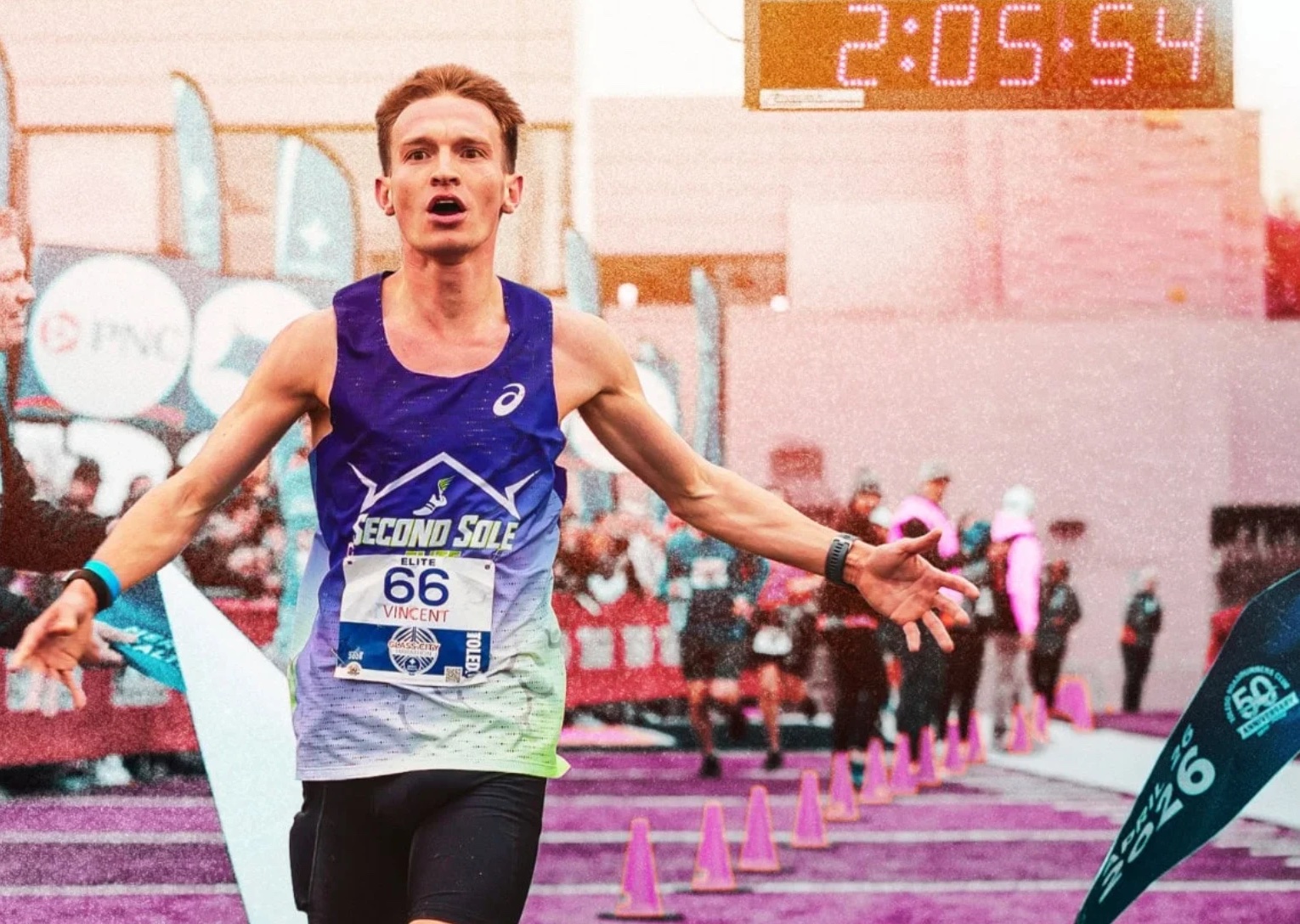
On 26 April 2026 Vincent Mauri won the Glass City Marathon in Toledo, Ohio, in 2:05:54. It was his first marathon; he had never raced an official half. He ran alone after the first 200 metres, with only current and average pace on his watch, in shoes he bought himself, and second place finished in 2:21:16. It is the fastest marathon debut by an American and the fourth-fastest American time ever. He was 25, living with his parents in Warren, Ohio, working at the Second Sole running store, coaching himself. He is not an amateur in the usual sense: he ran six years of NCAA Division I at Arizona State and Notre Dame (5000 m in 13:34, 18th in the 2022 NCAA final). But those six years were four coaches, a tibial stress fracture, a serious concussion in 2023 and two femoral-neck stress fractures in 2024 and 2025, each just before he was due to run his first 10,000 m. His Strava never shows a year above 4,700 km until 2026. After graduating in spring 2025 he stopped running almost completely for three months (0 km in May), ran only easy until October, and told his college coach he would give the marathon one year. Everything in this collection comes from his own Strava, which we went through by hand, week by week, from November 2024 to October 2026.
The assistant adapts these sessions to your event date, days and fitness — then drops the whole block on your calendar. One conversation, no blank calendar.
He stopped getting hurt
Strava kilometres by year: 4,695 in 2021, 4,003 in 2022, 2,170 in 2023, 4,678 in 2024, 2,888 in 2025 — and 6,173 in the first nine months of 2026. His college coach, Chris Neal, said he could already run 18 miles at 5:20 pace as a student and that the problem was doing too much at the wrong time. The breakthrough is the first nine uninterrupted months of his career.
Two hard days, no track
Tuesday is two threshold sessions, morning and evening. Sunday is the long run, usually with a progression. Everything else is steady running at 3:30–3:50/km — 75–82% of threshold pace, the top of zone 1 and the bottom of zone 2 for him — and one or two medium long runs. He did not set foot on a track in the whole debut block and ran about 25 miles of it in carbon shoes.
Volume was the target, pace was not
He brought the double-threshold day from Notre Dame — 'Double T W1.1' appears on his Strava in November 2024 as 5×2 km and 6×1 mile at 5:00 pace, about 60 minutes of work. On 8 September 2026 the same day was 2×50 min plus 4×20 min: 180 minutes at almost the same pace. The speed stayed; the minutes tripled.
The treadmill is a speed limiter
He ran about 800 miles of the winter on Planet Fitness treadmills. Weather is one reason; the other is his own: outside he cannot control the effort and speeds up, which is the habit that kept breaking him in college. The machines top out at 12.4 mph — 4:50 a mile, his marathon pace — and switch off after an hour.
- —How to read the percentages: they are % of threshold pace, and higher is faster. He does not test lactate, so the anchor is our estimate — his marathon pace (4:48/mile, 2:59/km) is set at 96% of threshold. Almost all of his 'threshold' work lands between 89% and 96%: at or just under marathon pace, not at lactate threshold. His everyday 3:30–3:50/km is 75–82%: genuinely easy running, zone 1 into low zone 2, that only looks fast in absolute numbers. Set your own targets from your own threshold pace and the sessions scale by themselves.
- —How the double Tuesday grew, in minutes of work per day: about 60 in November 2024 (college), 80 on 24 Feb 2026, about 100 in the weeks before Toledo, 115 on 23 June, 133 on 28 July, 135 on 25 August, 180 on 8 September. The recoveries shrank from 60 seconds to 20.
- —How the long run grew: 24–35 km through the winter, a marathon-pace test of 14 work miles three weeks before the debut, then 42.5 km on 28 June, 43.5 km on 2 August and 49 km on 30 August with the last 72.5 minutes at race pace.
- —What else changed after college, by his coach's account and his own posts: he eats for the training (he used to 'eat like a college guy'; now it is five meals the day before a double, four or five gels in a morning session and three or four in the evening), he lifts (three or four times a week early in the block), and he moves a session when he needs a day — 'just need a day to recover', 18 March.
- —This is not a plan to copy. In the peak week of September roughly a third of about 220 km was at or near race pace. Reviews of world-class marathoners describe 160–220 km a week with at least 80% of it at low intensity (Haugen et al., 2022), and in 16-week Strava logs from 119,000 marathoners the faster runners differ from the slower ones by the size of the easy layer, not by a bigger dose of hard running (Sports Medicine, 2024). Double-threshold days themselves are a description of how a few elite runners train; no trial has compared them with anything else.
- —If you run 4–6 times a week: take ONE of the Tuesday sessions, not both, and one long run with a short marathon-pace finish. Use the amateur version in each note. Two hard days a week is the ceiling he keeps himself, at three times the volume.
- —The part that transfers is not the workload. For six years he was fitter than his results because he could not train without interruption. The result came after he worked out what was breaking him, removed it — the track, the frequent racing, running too fast outdoors, under-eating — and gave himself a quiet year.
- —Honesty note: built from his own Strava, read by hand at the key weeks from November 2024 to October 2026 — titles, descriptions, distance and time. Most paces are treadmill readouts that nobody has calibrated. One athlete; no lactate, weight or sleep data. Written before the Chicago Marathon on 11 October 2026.
The sessions
Vincent Mauri's public Strava activities (athlete 43225488), November 2024 – 2 October 2026, read week by week. Background from LetsRun (Q&A with Chris Neal, 29 Apr 2026; Jonathan Gault, 2 Oct 2026), the CITIUS Mag podcast, Marathon Handbook (26 Jul 2026) and All Things Running (29 Apr 2026). Sources differ on the Toledo time (2:05:54 or 2:05:53) and on the 2025 injury. A reconstruction, not Mauri's own plan — he coaches himself and has published none. Cover: Mauri finishing the Glass City Marathon, 26 Apr 2026, image via Marathon Handbook.